Our Mission
Feasible solutions for modern economies.
We aim to develop and disseminate practical, majority-viable policy proposals to address the most pressing economic challenges facing highly developed countries.


About Us
The Atlas Research Foundation is an independent research initiative that develops scientifically sound and practically applicable proposals for forward-looking economic and social policy. Our goal is to make complex economic relationships understandable and to contribute to evidence-based political decision-making.
Who we are
What Atlas Stands For
Atlas stands for independent research with real societal impact. We combine economic analysis with practical policy design to develop solutions that are both scientifically rigorous and feasible in practice. Our work is grounded in data, evidence, and critical thinking—free from political or institutional interests. In this way, we build a bridge between academia, policymaking, and the public, helping to enable sustainable decisions for the society of tomorrow.


Our research focus
Current Challenges in Healthcare and Its Financing
Rising costs, shortages of skilled personnel, and an ageing population are placing increasing strain on healthcare systems. How can an efficient, high-quality, and financially sustainable healthcare system be designed?
Sustainable Pension Systems
Population ageing is pushing pension and retirement systems to their limits. How can the long-term financial sustainability of old-age provision be secured in the face of demographic change?
Education System
Due to different learning prerequisites, it is difficult to achieve qualification goals and reduce skill gaps. This negatively affects opportunities in the labor market. How can the education system respond better and adapt curricula effectively?
Public Finances
Rising public debt, growing deficits, and long-term spending risks are limiting the fiscal policy room of many OECD countries. What strategies can ensure budget consolidation, sustainable public finances, and effective responses to structural change?
Enhancing Competitiveness and Innovation
Declining productivity growth and weak investment are threatening economic dynamism. How can framework conditions be improved to foster innovation and sustainable growth?
Income Distribution
Technological change, globalization and shifting employment patterns are increasing income inequality. What measures can improve upward mobility and job prospects for low-income groups, and how can tax policy address these challenges?
Upcoming Events

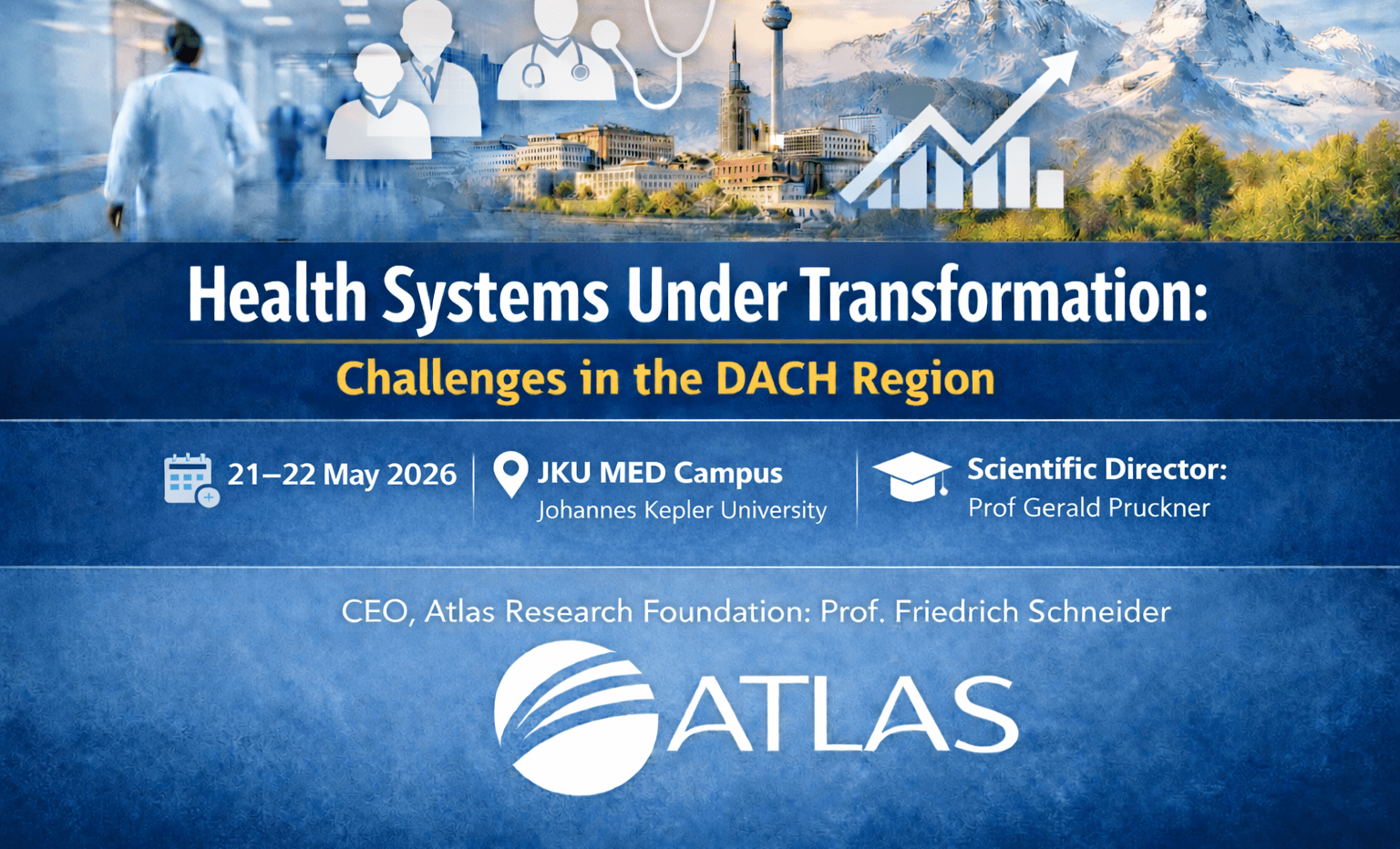
Health Care in Societal Transformation – A View of the DACH Region
How demographic change, workforce shortages, patient steering and medical innovation are shaping the future of health care in Austria, Germany and Switzerland.
20.05.2026 | JKU MED Campus Linz (medLOFT), 4020 Linz, Austria
The symposium report summarises the main findings from the discussions at the JKU MED Campus Linz and links directly to the full Knowledge Centre article.
Knowledge Centre
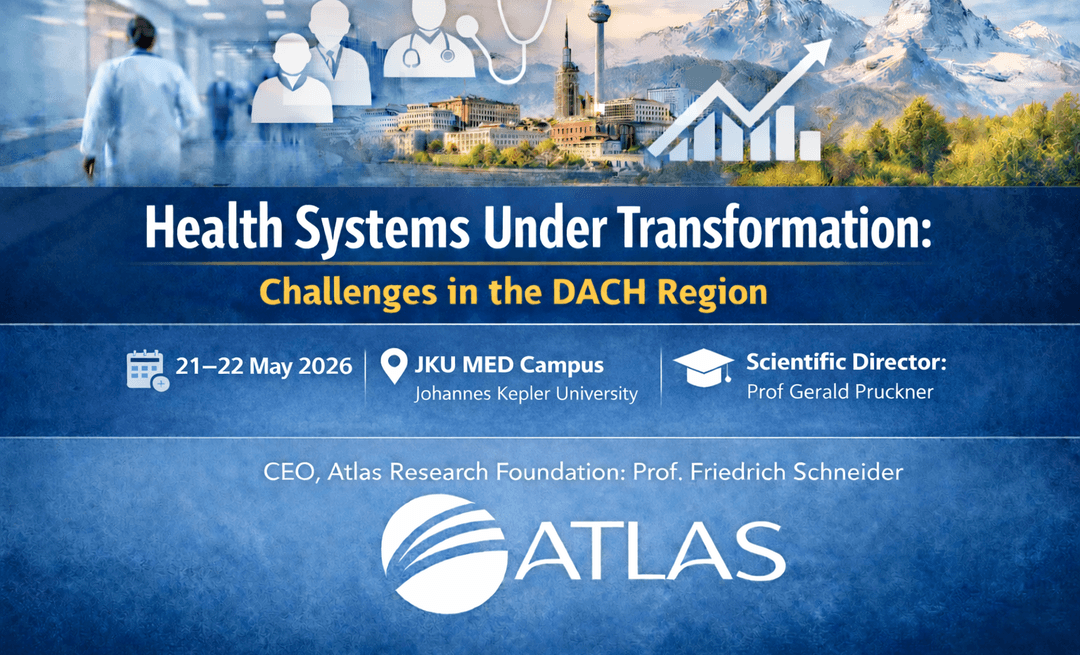
Health Care in Societal Transformation – A View of the DACH Region
How demographic change, workforce shortages, patient steering and medical innovation are shaping the future of health care in Austria, Germany and Switzerland.
Friedrich Schneider

Global Estimates of Informal Economies and New Insights for 152 Countries (1997–2022): Using an Enhanced Modelling Approach
Alban Asllani, Roberto Dell’Anno, Friedrich Schneider, Economic Analysis and Policy (2025), doi: https://doi.org/10.1016/j.eap.2025.11.027
Friedrich Schneider
Team


Prof. Friedrich Schneider
Founding Member and Head of Atlas Research Foundation
Professor Emeritus of Economics (JKU Linz) and Research Professor at DIW Berlin since 2006; his proven research interests include public finance, public choice, shadow economy, tax evasion, deregulation/privatization, environmental economics and money laundering.

Lic. Rer. Pol. Nicolas Thomet
Board Member
Nicolas Thomet is a founding partner of the Atlas Research Foundation. The former FXLM Global Head of Value Added Products at Citi currently serves as Chairman at Teres International AG. Furthermore, he is Head of Risk & Compliance and Board Member of Record Asset Management GmbH.

MBA, BA. Richard Preschern
Board Member
Richard Preschern is a founding partner of the Atlas Research Foundation. After 16 years as a currency and derivatives trader in Chicago he founded RoboSig, where he specializes in strategy optimization and risk management solutions.

Bc., BSc. Sebastian Tschernuth
Research Assistant
The Research Assistant holds a Bachelor’s degree in Biochemistry from the University of South Bohemia in Budweis (CZ) and Johannes Kepler University Linz (AT). He is currently pursuing a Master’s degree in Artificial Intelligence and has previously worked at the Chair of Intelligent Transport Systems at JKU. He now serves as a Data Scientist at FiveSquare. He supports Prof. Schneider with website maintenance and various research activities.